
Industrial Acoustic Camera War: Fluke II900 vs FLIR SI124
Energy efficiency and operational reliability are two core pillars in modern plant maintenance. One of the most common yet overlooked sources of waste is leakage in compressed air, gas, and vacuum systems. Based on industry studies, unaddressed minor leaks can result in operational cost losses of thousands of dollars every year.
Conventional detection methods—such as using soap water (bubble test) or listening manually for hissing sounds—are starting to be abandoned because they are slow and inaccurate in noisy factory environments. The presence of Sonic/Acoustic Imager technology changes this paradigm by mapping sound waves into a visual representation (SoundMap™) over real images.
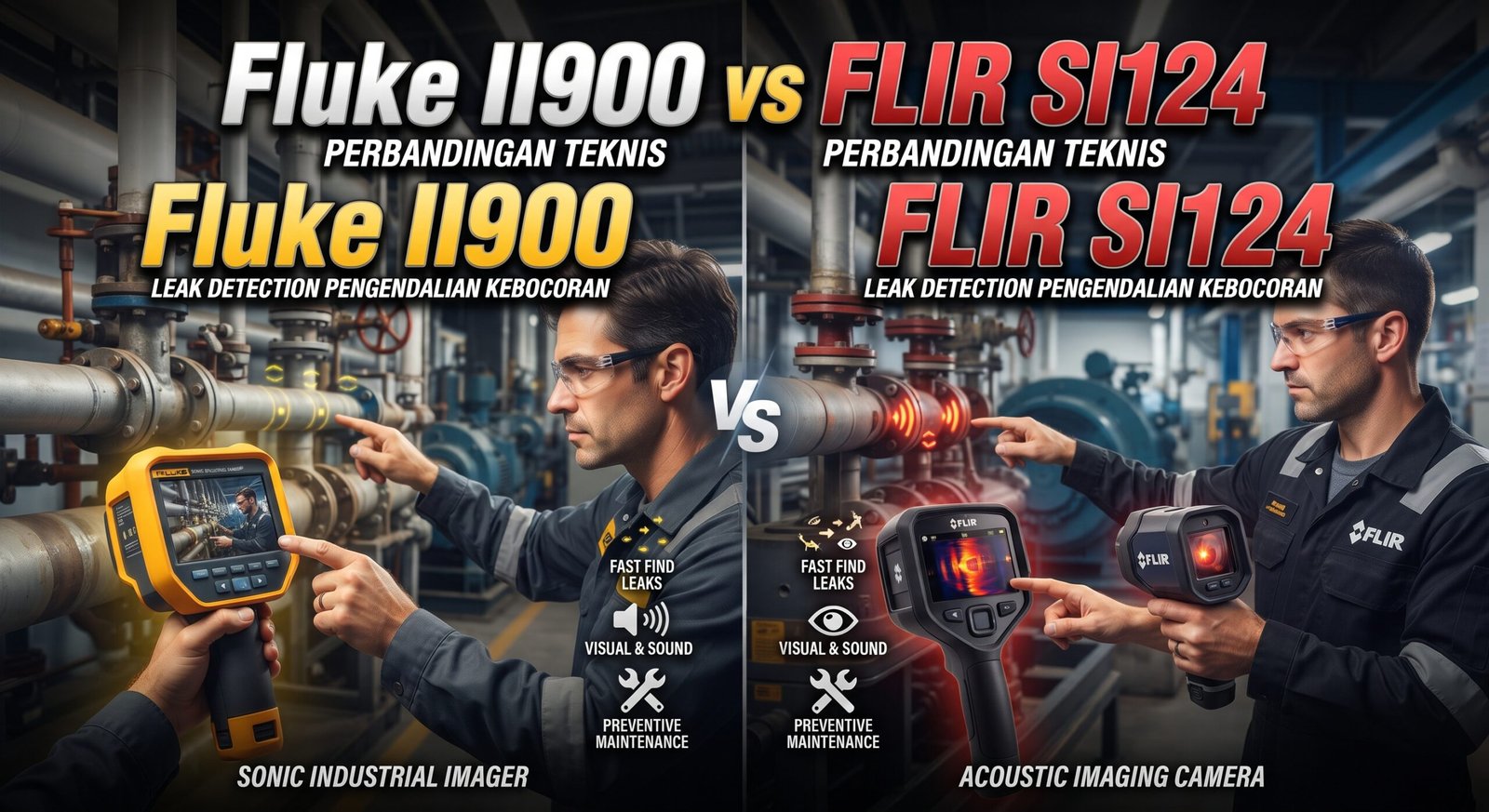
This article provides an in-depth comparison of two leading industrial acoustic imaging devices: the Fluke II900 vs FLIR SI124
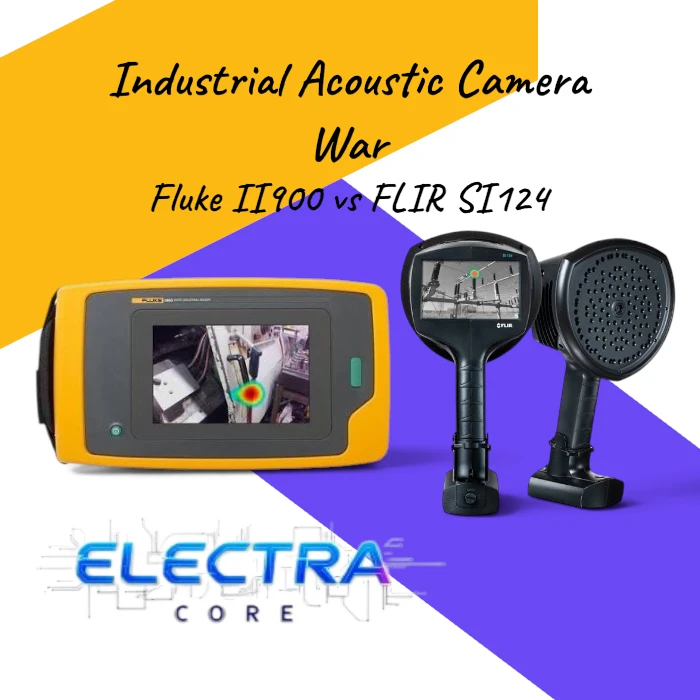
Table of Contents
Sensor Technology and Acoustic Resolution
The most fundamental difference between these two tools lies in the microphone sensor architecture used to capture ultrasonic waves in the air:
- Fluke II900: Relies on an array of 64 digital MEMS microphones. Although its microphone count is half of its competitor, Fluke optimizes its signal processing algorithm to cover a broad operational frequency range from 2 kHz to 52 kHz. This frequency range is ideal for filtering out factory background noise and isolating leak hissing frequencies.
- FLIR SI124: Delivers a more massive sensor density with 124 low-noise MEMS microphones. This high microphone count is designed to provide tight acoustic imaging resolution, helping operators visualize sound sources with high sharpness in complex areas.
Operational Convenience and Interface (Display)
The effectiveness of measuring instruments in the field is heavily determined by interface comfort for maintenance technicians:
- Fluke II900 is equipped with a 7-inch capacitive touchscreen with a 1280 x 800 pixel resolution designed to remain clear and sunlight readable. The larger screen size gives technicians visual freedom to directly view the SoundMap heat map in detail.
- FLIR SI124 uses a 5-inch touchscreen with an 800 x 480 pixel resolution. FLIR’s physical advantage lies in its relatively lighter total weight (around 1.23 kg with battery), providing extra comfort when holding the device during long inspection durations.
Data Management, Power, and Environmental Durability
In daily plant operations, device durability and data transfer convenience are crucial considerations:
- Battery Life: Fluke II900 excels in power supply duration with rechargeable Li-ion batteries capable of lasting up to 6 hours per battery (the sales unit even includes a spare battery and external dual-bay charger). Meanwhile, FLIR SI124 offers a standard operating time of around 2.5 hours per battery, but features a cloud-based data storage ecosystem (FLIR Thermal Studio & Acoustic Camera Viewer) along with integrated Wi-Fi connectivity.
- Physical Protection (IP Rating): FLIR SI124 features IP51 certification, providing slightly better protection against dust and vertical water drops compared to Fluke II900, which sits at the IP40 standard.
Frequently Asked Questions (FAQ)
- What is the main advantage of using an acoustic imager over traditional leak detection methods?Acoustic imagers convert sound waves into a real-time visual heatmap (SoundMap) overlaid on a visual image. This allows technicians to instantly locate air, gas, and vacuum leaks from a distance—even in loud factory environments—without stopping production or manually checking every pipe joint.
- Why does the Fluke II900 have fewer microphones than the FLIR SI124?While the FLIR SI124 uses 124 microphones for tighter sound resolution, the Fluke II900 uses 64 digital MEMS microphones paired with a broader frequency range (up to 52 kHz) and advanced signal processing to isolate background noise effectively.
- Which device is better suited for long inspection shifts?The Fluke II900 offers a significantly longer battery life of up to 6 hours per battery alongside a larger 7-inch display, whereas the FLIR SI124 is physically lighter (about 1.23 kg) with a 2.5-hour standard battery duration.
Conclusion and Recommendations
Choosing between the two depends on your facility’s operational priorities:
- Choose the Fluke II900 if you prioritize long-term field operational durability, large battery capacity (up to 6 hours), and a spacious 7-inch screen for direct visual analysis.
- Choose the FLIR SI124 if you need high sensor density (124 microphones) for tight sound resolution and seamless cloud and Wi-Fi data integration.