
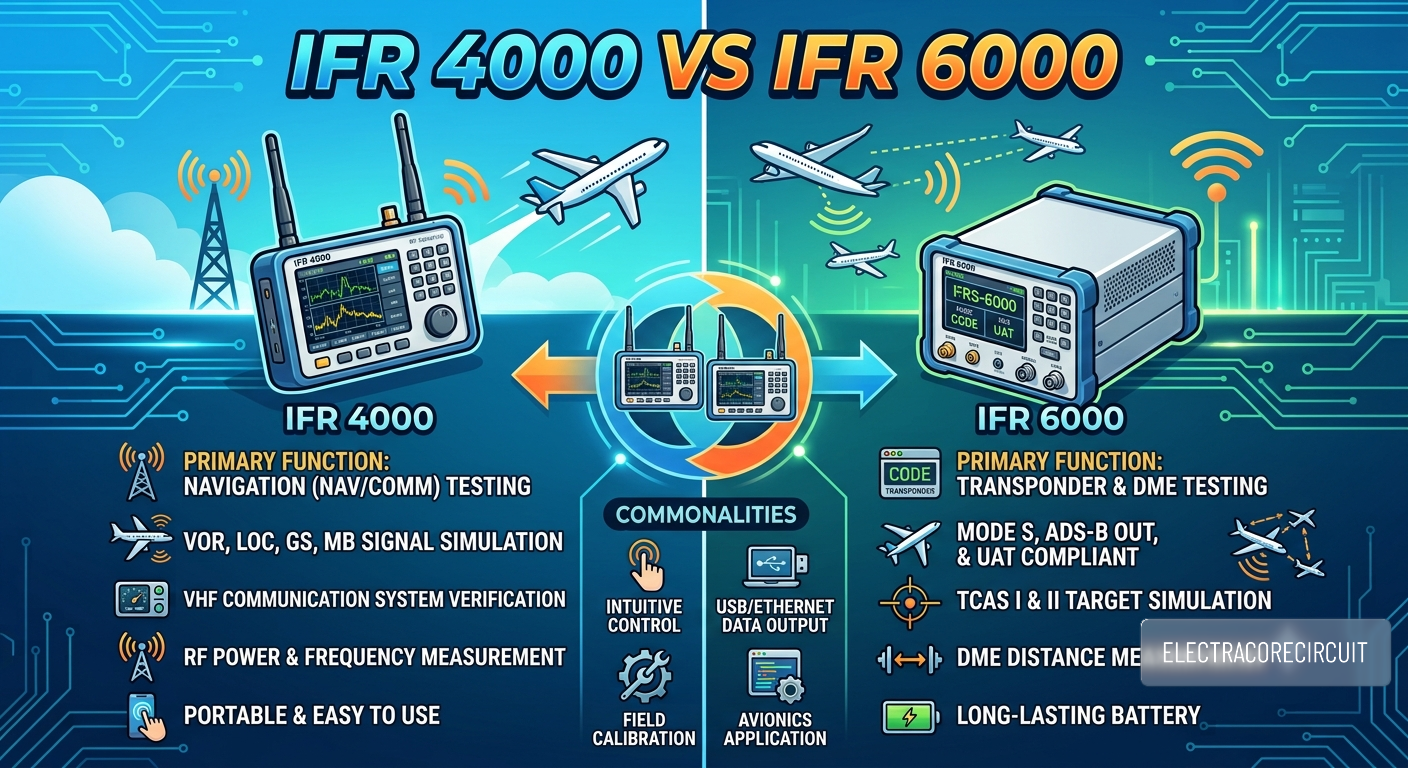
IFR 4000 vs IFR 6000
A Technical Breakdown for Avionics Technicians
In modern aviation maintenance, specialized flight line test sets are essential tools for verifying system airworthiness, ensuring regulatory compliance, and minimizing aircraft ground time. Among the most widely deployed ramp test units in civil and military hangars worldwide are the IFR 4000 vs IFR 6000 (originally developed by Aeroflex / IFR, now under VIAVI Solutions).
While both instruments share a nearly identical exterior hardware architecture—utilizing the same 5.7-inch color display, lightweight 8 lb portable enclosure, and intuitive menu-driven interface—they are engineered to diagnose entirely different RF sub-systems aboard the aircraft.
This technical breakdown examines the distinct operational domains, testing capabilities, and practical hangar applications of the IFR 4000 vs IFR 6000 to help avionics technicians, lead inspectors, and line maintenance supervisors properly deploy and leverage each unit.
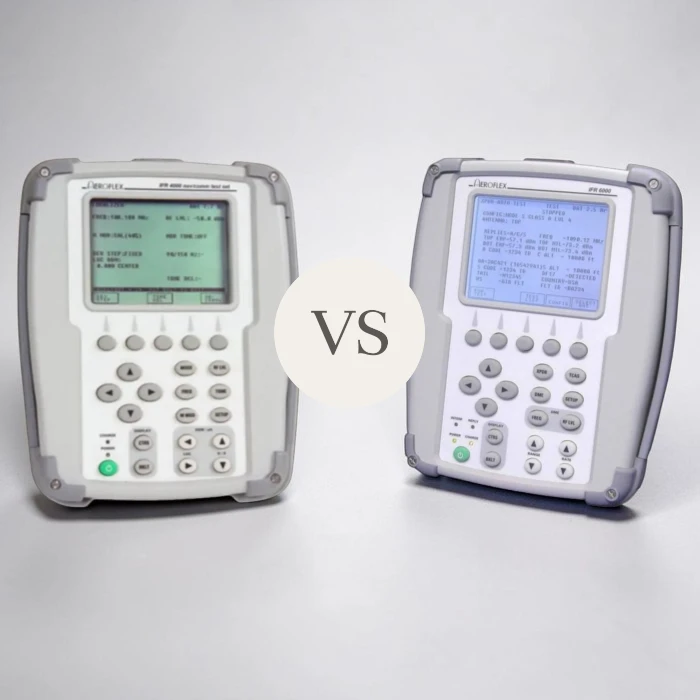
Table of Contents
Core Operational Distinction
The fundamental difference between the two units lies in the avionics domain they are engineered to test:
- IFR 4000: Designed for Navigation (NAV) and Communication (COMM) systems. It acts primarily as a RF signal generator and receiver to test VHF/UHF radios, ILS receivers, VOR navigation, Marker Beacons, and Emergency Locator Transmitters (ELTs).
- IFR 6000: Designed for Pulse and Surveillance systems. It functions as a target/interrogator simulator to test Transponders (Mode A/C/S), ADS-B Out/In, Distance Measuring Equipment (DME), and Traffic Alert and Collision Avoidance Systems (TCAS I/II).
In short: IFR 4000 tests how the aircraft communicates and navigates along airway corridors, whereas IFR 6000 tests how the aircraft tracks distance, identifies itself, and avoids other traffic.
Detailed System Capabilities
1. The IFR 4000: NAV/COMM Ramp Test Set
The IFR 4000 provides total verification of installed analog and voice communication systems, along with terrestrial radio-navigation receivers.
Key Target Systems Tested:
- VHF/UHF COMM Transceivers: Tests transmitter output power, frequency accuracy, AM/FM modulation depth, and receiver sensitivity across HF, VHF (118–136 MHz), and UHF (225–400 MHz) bands.
- ILS (Instrument Landing System): Simulates Localizer (LOC), Glideslope (GS), and Marker Beacon (MB) RF signals simultaneously for autopilot coupling tests (swept DDM) and cockpit indicator alignment.
- VOR (VHF Omnidirectional Range): Generates variable VOR bearing signals to verify cockpit RMI/HSI accuracy and bearing selection.
- Emergency Locator Transmitters (ELT): Decodes and measures 121.5 MHz, 243 MHz, and 406 MHz COSPAS-SARSAT beacons, including protocol hex-code decoding and power/frequency evaluation.
- SWR Measurement: Measures Standing Wave Ratio (SWR) for HF, VHF, and UHF antenna feeders directly at the aircraft installation.
2. The IFR 6000: Transponder / DME / TCAS / ADS-B Flight Line Test Set
The IFR 6000 focuses on pulse-based transponder and collision-avoidance avionics, making it indispensable for 14 CFR Part 43 Appendix F certifications and ADS-B operational checks.
Key Target Systems Tested:
- ATCRBS & Mode S Transponders: Verifies Mode A/C/S transponders, checking receiver sensitivity, peak transmitter power, pulse spacing, and Elementary/Enhanced Surveillance (DAPs) parameters.
- ADS-B (1090 MHz & 978 MHz UAT): Decodes and monitors ADS-B Out parameters (position, velocity, squitter) and generates target traffic to verify ADS-B In systems.
- DME (Distance Measuring Equipment): Simulates a ground station on any of the 126 X or Y DME channels to test aircraft interrogator distance tracking, PRF, and velocity accuracy.
- TCAS I & II: Simulates intruder aircraft scenarios (converging altitude and range) over-the-air or direct-connect to verify RA/TA cockpit alerts and resolution advisories.
Technical Specifications & Comparison
While both instruments utilize a similar rugged casing and long-life Lithium-Ion battery setup, their internal RF architecture is tailored specifically for their respective tasks.
| Parameter / Feature | VIAVI / Aeroflex IFR 4000 | VIAVI / Aeroflex IFR 6000 |
|---|---|---|
| Primary Focus | NAV / COMM / ELT Testing | Pulse / Transponder / TCAS / ADS-B |
| Frequency Range | 1.5 MHz – 400 MHz (HF/VHF/UHF) | 960 MHz – 1215 MHz (L-Band Pulse) |
| RF Signal Generation | CW, AM, FM, VOR/ILS audio tones | Pulse-modulated radar & data bursts |
| Antenna Type | Tri-mode telescopic / whip antenna | Directional L-band antenna |
| Key Regulatory Standard | Radio comms & navigation alignment | FAR Part 43 Appendix F compliance |
| Typical Battery Life | Up to 8 Hours continuous | 6+ Hours continuous |
| Weight | ~8 lbs (3.6 kg) | ~8 lbs (3.6 kg) |
Operational Workflow in the Field
In an active MRO (Maintenance, Repair, and Overhaul) environment or flight line shop, these two units are rarely viewed as competitors; rather, they are complementary tools.
Scenario A: Annual Avionics Inspection / FAR Checks
During a routine annual airworthiness inspection on a general aviation or business jet:
- The technician uses the IFR 4000 to sweep the VHF COM radios for frequency drift, check the VOR/ILS receiver response before instrument flight authorization, and verify that the 406 MHz ELT isn’t radiating spurious signals.
- The technician then switches to the IFR 6000 to execute the mandatory 24-month transponder check under FAR 91.413 / Part 43 App. F, confirming Mode S squitter data and ADS-B Out GPS position accuracy.
Scenario B: Flight Line Troubleshooting
- If a pilot reports “No DME readout on NAV 1”, the technician pulls the IFR 6000.
- If a pilot reports “Static on COMM 2 during transmission” or “Glideslope flag dropping on ILS approach”, the technician pulls the IFR 4000.
Transition Notice: The AVX-10K Platform
It is worth noting for line supervisors and purchasing departments that while thousands of IFR 4000 and IFR 6000 units remain active globally, VIAVI Solutions has transitioned toward the unified AVX-10K Flight Line Test Set platform.
The AVX-10K combines the capabilities of both the IFR 4000 and IFR 6000 into a single touchscreen device depending on software licensing (e.g., AVX-10K-NAV, AVX-10K-SVLC, or AVX-10K-CNS). However, on active ramp lines today, the dual-unit setup (IFR 4000 vs IFR 6000) remains an industry standard.
Conclusion: Which One Do You Need?
Choosing between the IFR 4000 vs IFR 6000 comes down to your shop’s specific work scope:
- Select the IFR 4000 if your primary work involves radio communications, navigation receiver installation, antenna SWR troubleshooting, and ELT battery replacement certifications.
- Select the IFR 6000 if your shop performs biennial transponder recertifications, ADS-B Out modifications, TCAS checks, or DME maintenance.
- Acquire Both if you operate a full-service Part 145 repair station or flight line maintenance crew requiring complete Aircraft Maintenance Manual (AMM) coverage across communication, navigation, and surveillance systems.